Executive Summary
Designing and manufacturing custom luxury display cabinets for jewelry, fine watches, and boutique eyewear requires balancing aesthetic prestige, spatial engineering, physical security, and strict international compliance. Drawing on direct factory benchmarks from Bannama, this engineering guide outlines material selection, optical lighting rules (PSE-compliant CRI 90+ LEDs), anti-theft mechanics, dual-facility factory scheduling, and global freight workflows (RTA vs. assembled export crating) necessary to execute bespoke retail fit-outs seamlessly.
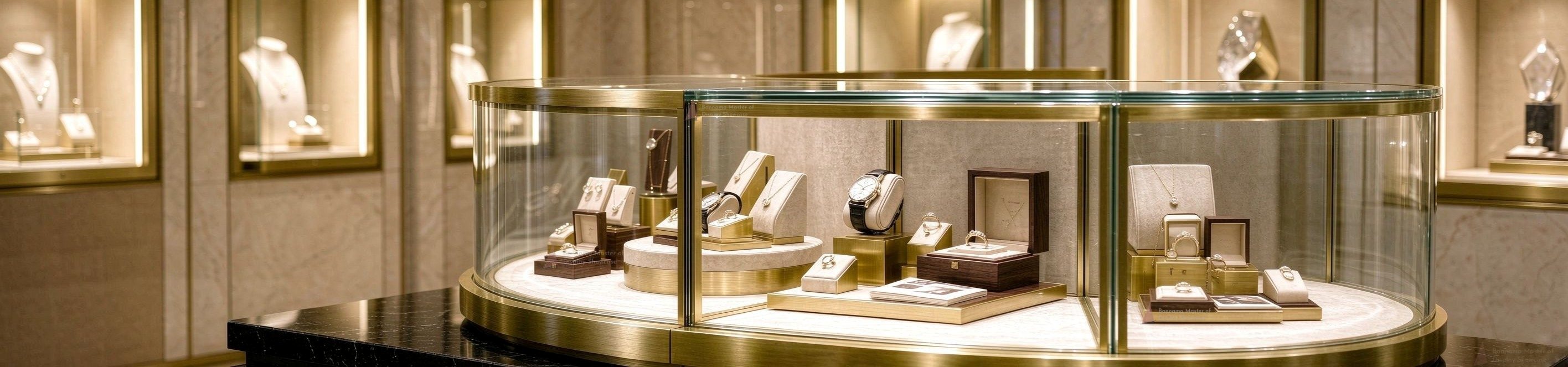
In high-end retail merchandising, spatial presentation directly drives product value perception. Whether showcasing certified diamond necklaces, multi-axis tourbillon timepieces, or bespoke designer eyewear, a retail display cabinet is not simply furniture—it is an architectural micro-environment. It must illuminate minute details without glare, protect ultra-valuable assets against theft, and embody the visual identity of a luxury house.
Yet, brand managers, retail interior architects, and store developers frequently encounter costly execution bottlenecks. Common friction points include mismatched color rendering, joint visibility in glass bonding, structural instability under heavy security loads, and transit damages that delay store grand openings. Resolving these challenges requires moving away from generic shopfitting and implementing direct-to-manufacturer engineering workflows from initial 3D design to global logistics.
1. Structural Material Selection for Bespoke Retail Showcases
The longevity and tactile quality of a luxury showcase depend directly on substrate integrity. Commercial retail environments experience constant customer contact, cleaning abrasives, and ambient humidity fluctuations. Inferior composite boards warp, cheap veneer delaminates, and low-grade stainless steel scratches or discolors.
| Substrate Category |
Material Standard & Grade |
Technical Advantage |
Primary Application |
| Carcass & Structural Core |
FSC-Certified E0/Carb P2 Moisture-Resistant MDF |
Zero surface texture telegraphing, exceptional dimensional stability, high screw-holding torque. |
Plinths, base cabinets, curved wall fixtures. |
| Metal Architecture |
Grade 304 / 316 Stainless Steel (PVD Coated) |
Corrosion immunity, scratch-resistant molecular finish, seamless hairline or mirror buffing. |
Display frames, reveal lines, central island edge guards. |
| Glazing Hoods |
Ultra-Clear Low-Iron Tempered & Laminated Glass |
91.5%+ light transmission, zero greenish tint, 45-degree UV-cured miters, shatter containment. |
Viewing hoods, vitrine cubes, sliding glass access. |
| Interior Liners |
Anti-Tarnish Synthetic Microfiber, Velvet & PU |
Sulphur-free composition to prevent silver/gold oxidation; soft touch; non-reflective light scatter. |
Watch collar displays, jewelry insert trays, plinth pads. |
The foundation of bespoke joinery starts with the wooden core. Utilizing FSC-certified chain-of-custody timber and eco-friendly moisture-resistant boards ensures that showcases comply with global environmental standards while remaining inert within climate-controlled retail boutiques. For the outer metal accents, Physical Vapor Deposition (PVD) titanium plating over hairline stainless steel provides superior wear resistance compared to electroplating, ensuring display corners do not tarnish or chip under routine cleaning.
2. Display Showcase Lighting: Optics, Thermal Management, and PSE Compliance
Lighting is the active engine of merchandise conversion. A poorly illuminated showcase flattens diamonds, distorts gold tones, and causes reflective eyestrain. Furthermore, high-powered LED arrays generate concentrated heat inside closed glass volumes. If left unmanaged, trapped heat degrades luxury watch lubricants, yellows leather accessories, and shortens the lifespan of the diodes.
A. Color Temperature (CCT) by Merchandise Category
- Fine Diamonds & Platinum (5000K – 6000K): Crisp, high-kelvin white light enhances fire, scintillation, and dispersion across brilliant-cut facets without blue casting.
- Yellow Gold, Pearls & Rose Gold (3000K – 3500K): Warm white illumination accentuates rich metallic luster and skin-flattering tones without skewing dull amber.
- Luxury Watches & Horology (4000K – 4500K): Balanced neutral white illuminates brushed and polished metal transitions, sunburst dials, and ceramic bezels with clinical precision.
- Eyewear & Optical Displays (4000K Neutral with High Diffuse Ambient): Focuses on edge contrast for acetate and titanium frames, avoiding hard specular hot-spots that impede prescription trials.
B. Color Rendering Index (CRI) and Electrical Certification
All showcase installations require a minimum CRI of Ra ≥ 90, with special attention to the R9 value (saturated red), which should be maintained above 80. When evaluating electrical assemblies, commercial property managers and retail mall authorities enforce strict safety inspections. Low-voltage DC12V/24V micro-track systems, hidden downlights, and miniature linear LED ribbons must hold verified electrical safety and electromagnetic compatibility certifications, such as Japan's PSE mark (J 55015 / IEC 60598-series compliance) and CE/UL equivalents. Certified drivers ensure no radio frequency interference disrupts local wireless card terminals, while integrated micro-aluminum heat sinks passively route thermal buildup down into the base plinth.
3. High-Security Vitrine Engineering: Anti-Theft and Glass Joint Integrity
Security in a luxury boutique must be absolute yet completely invisible. High-profile retail targets demand glass chambers engineered to withstand sudden brute-force impacts and sophisticated lock picking, all while maintaining a visually weightless glass aesthetic.
UV-Cured 45-Degree Miter Bonding
Traditional mechanical clamps or visible silicone glue joints distract from merchandise. Precision showcases employ 45-degree CNC-beveled edges bonded with high-tensile ultraviolet (UV) curing optical adhesives. When exposed to calibrated UV light frequencies, the liquid polymer undergoes molecular cross-linking with the glass, achieving shear strengths exceeding the glass substrate itself. The bond line is crystal clear, bubble-free, and resistant to environmental yellowing over decades of use.
Security Glazing and Concealed Hardware
Depending on risk assessment, vitrine glass specifies either 8mm/10mm monolithic low-iron tempered glass or multi-layer safety laminated glass (e.g., 5mm Low-Iron + 1.52mm SentryGlas/PVB + 5mm Low-Iron). Laminated formulations guarantee that even under repeated hammer blows, the pane cracks into an impassable web without collapsing inward, securing high-ticket pieces until alarms trigger.
Locks are concealed within the stainless-steel perimeter profile or lower wooden apron. Options range from precision mechanical dimple locks with master-key systems to electronic RFID/NFC sensor locks buried invisibly behind veneer panels. The result: zero visible keyholes disrupt the clean exterior architecture of the counter.
4. Turnkey Customization Workflow: From Floor Plan to Installation
Bespoke display fixture manufacturing requires an engineered sequence of checkpoints. A disorganized workflow leads to dimensional mismatches on site, non-functioning electricals, and extended project delays. An established turnkey OEM/ODM workflow operates along five defined phases:
1
Architectural Consultation & Floor Plan Review:
Reviewing spatial layouts, floor plan CAD files, ceiling heights, electrical drops, customer traffic flows, and sightlines to determine wall cabinet dimensions and central island clusters.
2
3D Photorealistic Rendering & Construction Shop Drawings:
Translating creative brand books into structural shop drawings with 1:1 joinery details, metal reveal tolerances, material callouts, and internal electrical layouts.
3
Prototyping & Material Approval:
Physical swatches of PVD metals, lacquered paint panels, fabric liners, and glass corner samples are submitted to brand directors. For rollouts, a full-scale mock-up unit verifies lighting angles and ergonomics.
4
Factory Fabrication Under 6S Quality Control:
Execution within specialized dust-free spray booths, precision laser metal processing lines, and carpentry workshops. Continuous stage inspections check drawer glide tolerances, lock alignments, and power consumption.
5
100% Pre-Assembly and Live Client Inspection:
At Bannama, entire store suites are fully assembled on our factory floor prior to packaging. Clients verify alignments, fitments, and finishes either through in-person factory visits or real-time 4K live video streaming inspections before final dispatch.
5. Production Capacity, Lead Times, and Dual-Facility Scheduling
Manufacturing speed without structural compromise is vital during peak retail fit-out seasons. Brand rollouts often operate under tight commercial leases where opening delays trigger heavy financial penalties.
To satisfy both bespoke single-unit requirements (MOQ from 1 unit) and high-volume global store rollouts, production scheduling benefits significantly from dual-facility operations. Operating across dual production bases in Shenzhen and Huizhou, Bannama leverages over 4,000 square meters of specialized metal fabrication, rapid prototyping, and large-scale carpentry facilities to provide true capacity elasticity.
Standard Manufacturing Lead-Time Benchmarks
- In-Stock / Standard Showcase Modifications: 10 – 15 working days.
- Fully Bespoke Single Boutiques (Island & Wall Cases): 20 – 25 working days.
- Multi-Store Commercial Rollouts (30+ Units): Scheduled rolling delivery batches within 25 – 35 working days.
Cross-workshop synchronization ensures that glass tempering, PVD metal electroplating, wood lacquer curing, and electrical harness pre-wiring occur in parallel paths rather than sequential bottlenecks.
6. Packaging Engineering and Global Freight Logistics
A showcase completed to perfection is useless if it arrives on-site with shattered glass, sprung hinges, or gouged veneer. Global sea, air, and rail transit impose substantial mechanical shocks, harmonic vibrations, and moisture variations.
Packaging Topologies: RTA vs. Pre-Assembled
- Fully Assembled Export Crating: Standard for luxury counters and vitrines. Cabinets arrive fully assembled with pre-tested lighting and locks. Units are wrapped in anti-static film, corner-guarded with high-density EPE foam, encased in heavy-duty double-wall cartons, and bolted inside fully enclosed, fumigated marine-grade plywood crates. On site, contractors simply uncrate, position, level, and connect to floor power.
- RTA (Ready-to-Assemble) Modular Packaging: Recommended for oversized perimeter wall systems, ceiling-height shelving, and high-volume standard modules. Reduces shipping volume (CBM) by up to 60%, significantly lowering air or sea freight expenses for budget-conscious international store expansions. Includes standardized cam-lock joinery and numbered visual assembly manuals.
Global Port Access and Forwarding Networks
Positioning manufacturing bases in southern China provides streamlined logistics access via major deep-water transport hubs, specifically Shenzhen Port (Yantian/Shekou) and Hong Kong Port. Ocean transit windows to major global destinations typically run:
- Southeast Asia (Singapore, Bangkok, Jakarta): 7 – 12 days port-to-port.
- Europe (Rotterdam, Hamburg, Felixstowe): 28 – 35 days port-to-port.
- North America (Los Angeles, Long Beach, New York): 15 – 28 days port-to-port.
- Middle East (Jebel Ali, Dammam): 18 – 25 days port-to-port.
For clients importing commercial joinery from China for the first time, partnering with a direct factory like Bannama that provides complete DDU/DDP (Delivered Duty Unpaid / Delivered Duty Paid) logistics services removes complexity. Professional overseas freight forwarders handle ocean carriage, destination port customs clearance, import documentation, and hydraulic-tailgate truck delivery directly to the retail jobsite.
7. Frequently Asked Engineering Questions (B2B Showcase Procurement)
Q: What is the minimum order quantity (MOQ) for custom luxury display cabinets?
A: The minimum order quantity is one (1) unit. Bannama engineers and fabricates both individual flagship feature vitrines and high-volume rollout orders across international retail chains.
Q: How can retail brands verify manufacturing tolerances before overseas shipping?
A: At Shenzhen Bannama Technology Co., Ltd., quality verification is maintained through three options: client or third-party (e.g., SGS/Bureau Veritas) on-site audits in our Shenzhen/Huizhou workshops, real-time 4K live-stream pre-assembly reviews, and detailed high-resolution photographic/video staging reports submitted before crating.
Q: Can display lighting be customized to adhere to specific local national electrical codes?
A: Yes. All internal transformers, drivers, and LED light modules are selected to match regional safety directives, including PSE (Japan), CE (European Union), and UL-listed requirements (North America), ensuring smooth commercial fire and electrical inspections on-site.
Q: What information is needed to receive an accurate factory quotation quickly?
A: To receive a formal proposal within 24 hours, provide: your retail floor plan or cabinet dimension sketches, target material specifications (e.g., brushed stainless steel color, timber veneer type, glass thickness), desired quantities, and the destination delivery port.